




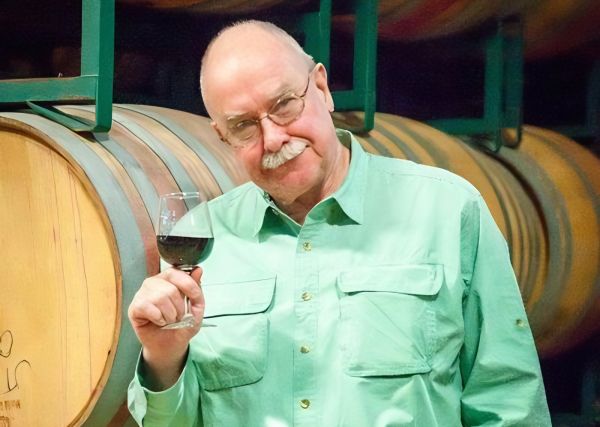
Winemaker Jed Steele
Winemaker Jed Steele passed away this week. Steele’s contributions to the Lake County and California wine industries have been well-documented. Here, I want to touch on Steele’s Washington connections and also a personal one.
Steele attended Gonzaga University on a basketball scholarship. While in Spokane, Washington, Steele, who grew up in San Francisco, found himself drawn to the place and its surrounding environs.
“Unexpectedly, I fell in love with the area,” Steele told me in 2015.
Steele subsequently bought property in the Spokane area. He planted an experimental vineyard there in the mid-‘70s.
Steele travelled to Prosser and met with Dr. Walter Clore, officially recognized as the father of Washington wine. The two discussed what varieties might do best at Steele’s site. Clore recommended Lemberger, a grape grown principally in Austria.
“They had made experimental wines out of it [at the Prosser station],” Steele said. “They had me taste them, and they were very good.”
Alas, traveling back and forth from California to Washington to tend the vineyard was difficult, and Steele ended up selling the property. However, his talks with Clore planted a seed.
Flash forward to 1991. After Steele left Kendall-Jackson, he began consulting for Stimson Lane (now Ste. Michelle Wine Estates), the parent company of Chateau Ste. Michelle. Ste. Michelle sourced Lemberger grapes but put them into a red blend. Steele asked permission to buy the grapes to put under his own, recently started label, Shooting Star.
Despite the delightfulness of the variety, the name Lemberger doesn’t roll off the tongue. Blaufränkisch, as it is called in Austria, is considerably more challenging. Steele decided give the latter name a twist.
“I just took the Austrian name and anglicized it to Blue Franc to make it easier to say,” Steele explained.
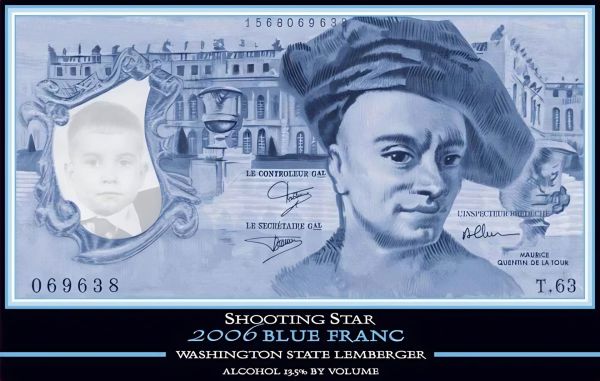
The Shooting Star Blue Franc had a distinctive label: a 50 Franc note given a blue hue. The label caught my eye in the early aughts as I first became interested in wine. Enjoying the bottle, I subsequently purchased the Kiona Lemberger, which sat next to it on the shelf.
 Inspired, a few years later in 2004, I visited Kiona and other wineries on Red Mountain. Almost immediately thereafter, I started Washington Wine Report. (I renamed this site Northwest Wine Report in 2023.)
Steele had much more substantial contributions to Washington wine than promoting Lemberger or influencing my early career. Most notably, Steele started Northstar, Stimson Lane’s Merlot-focused winery.
“Northstar wouldn’t be here if it wasn’t for him,” David Merfeld, long-time winemaker at Northstar, told me after Steele’s passing. Merfeld worked with Steele and considered him a mentor and friend.
These are, of course, minor chapters in Steele’s large book. To me, however, these few stories perfectly capture the profound impact that wine, and the people like Jed Steele who make it, can have, along with the role of serendipity.
A basketball scholarship takes Steele to the Northwest where he subsequently becomes interested in Lemberger. Decades later, returning to the state, he makes the variety with an eye-catching blue label that inspires someone newly interested in wine and helps set them on a life-long path. I’m sure an untold number of people could tell similar stories about wines Jed Steele made.
Wine spurs our curiosity. It dispatches us on journeys – figuratively and literally – to places near and far. Wine sends us down rabbit holes, reading about obscure varieties, the history behind them, and the people and places that grow them. As if on a pilgrimage, we are drawn there. Something as simple as a $10 bottle with a blue bank note label has the potential to alter the course of someone’s life. And when someone like Jed Steele passes, a little of that potential is lost forever.
I thank Jedediah Tecumseh Steele for the inspiration he provided in my own wine journey. Looking up at the night sky, there’s sure to be a bright shooting star tonight.
Do you enjoy Northwest Wine Report? If you do and haven’t already, please subscribe during our FALL SUBSCRIBER DRIVE. Northwest Wine Report is 100% subscriber funded. Subscribe here. It’s the cost per month of a cup of coffee and a crumpet. To those who have subscribed, thank you! You power this site.



Sean,
This is a very interesting article and one that is well written.
It reminds me of how important your Report is to Wine making in the Pacific Northwest and to readers like me.
Best wishes
Thanks, Andrew!
This is a great article. As a follow-up, I would be very interested for you to write about what has happened with Lemberger in Washington in the past 20 years, and its status today.
Stephen, Lemberger’s story in Washington has been modest. Kiona made the first commercial bottling of Lemberger in 1980. The winery planted it at their vineyard on Red Mountain in 1976. It continues to be a standout bottle from the winery and an exceptional value. Kiona made 3,400 cases of Lemberger in the 2022 vintage. This is by far the largest production of Lemberger in Washington.
Beyond that, it is a minor player and is lumped in with “Other reds” in both the acreage and the tonnage reports. Dr. Walter Clore and others originally thought Lemberger would do well in Washington because of the area’s cool, northern climate. However, over the ensuing 50+ years, temperatures have warmed considerably, and the reality is that eastern Washington has a short, hot growing season.
To wit, when Kiona planted Cabernet Sauvignon on Red Mountain in 1975, there was little reason to think it would be successful. Today, it makes up over 60% of plantings there. So long story short, the state has focused largely on other varieties beyond (relatively) cool climate ones like Lemberger. Still, it continues to be grown here.
I am Jed’s nephew (son of Jed’s eldest sister, Clelia). Along with my brother, Adam (a winemaker who earned his wings as Jed’s understudy over several years), we helped sink the posts at Jed’s Spokane property. 55-gallon barrels, creosote, and long hours following the tractor to direct the auger. We had a gas as Jed was the best of company and a doting uncle (he took us to a J. Geils concert while we were there!) Thanks for sharing the story of his Washington venture and Blue Franc.
Brittain, what a great story! Thank you for sharing it. My condolences to you and your family on the passing of your uncle.
I’m glad to see my (older and somewhat less charming) brother posted after reading your article.
I am Adam, the brother referred to in Brit’s post. I remember that trip to Spokane well. We stayed with Jed’s friend, Mel the spud farmer, that’s how he was introduced. I also remember sitting by the road with Jed and Brit while we ate fresh raspberries and drank 1970 d’Yquem from the bottle.
I ended up planting Blaufrankisch in the vineyard I managed, and where I was winemaker, on the Leelanau Peninsula in northern Michigan. The variety worked great in our climate but was distinctly different than Jed’s. We traded bottles back and forth over time but it was my Sparkling Riesling Jed always wanted.
I spent many years in Jed’s presence, from him spending time with my family in Ohio when he was a teen, to my time living and working in the Anderson Valley with Jed at Edmeades. Jed was family first and foremost.
I know and respect Jed’s enormous impact on the wine industry on many levels. I will always remember the impact he had as a person. Mentor to many, friend to many, and always ready to enjoy an adventure.
I must also add that the beast that Jed created, the infamous Kendall Jackson Vintners Reserve Chardonnay, was a result off a great many serendipitous events.
I remember Jed and I testing and tasting any and every Chardonnay we could get our hands on while working at Edmeades. We were searching for the relationship between residual sugar and specific fruit acids. We were consistently surprised by the levels of RS in these wines, especially those from Burgundy. After some time we came to the conclusion that RS in Chardonnay was the norm. In Burgundy it seemed to be due to the common use of “natural/indigenous” yeasts favored. In California you had the monster that was Glen Ellen Reserve Chardonnay, and what became known as the “fighting varietals”. They all leaned heavier on RS than the most realized.
All the stories of how KJ Chardonnay became the darling of America, it was Nancy Reagan s favorite wine, are wonderfully delightful and romantic. I was there, I know how it actually happened. Jed and I tasted all the blending trials and the truth ain’t out there yet about this groundbreaking wine. It became clear that Jed actually did know how to make a silk purse from a sow’s ear.